
Solutions SMC · TEKIS
Vacuum solutions: ejectors, pads, switches and filters


Vacuum handling is the fastest way to pick up sheets, cartons, bags, glass, PCBs and food products without damaging them. A well-designed vacuum circuit is also one of the simplest: an ejector or pump, a pad, a filter and a switch. This page covers how to choose each of them, how to size a system and how to cut the air it consumes.
How a pneumatic vacuum circuit works
In most machines the vacuum is generated locally by an ejector: compressed air passes through a nozzle, accelerates, and draws air from the suction port. There are no moving parts, the response is instantaneous and the unit sits right next to the pad, so the evacuated volume is tiny. Central vacuum pumps are used where many pads work continuously or where compressed air is not available.
The pad is the interface with the product. Its material, shape and diameter decide the holding force, the resistance to the product surface and the service life. Between pad and ejector sits a filter that keeps dust out of the nozzle, and a vacuum switch that confirms the part is held before the robot moves.
Components of the circuit
Vacuum ejectors
Single-stage ejectors (ZH) for simple circuits; ZK2 units with integrated supply valve, release valve, filter and switch; multi-stage ZL for high suction flow and porous products such as cardboard or wood.
Vacuum ejectors →Vacuum pads
Flat pads for rigid, smooth parts; bellows for uneven or tilted surfaces and height compensation; heavy-duty pads for metal sheets; oval pads for narrow parts; sponge and foam pads for porous surfaces.
Vacuum pads →Vacuum switches
Digital switches (ZSE10, ZSE20) with display and switching outputs confirm pick-up, detect a missing part and allow the cycle to continue only when the vacuum level is safe.
Vacuum switches →Vacuum filters
In-line filters (ZFC, ZFA, ZFB) protect ejector nozzles and switches from dust and paper fibres. Transparent cases show when an element needs changing.
Vacuum filters →Vacuum saving valves
ZP2V valves close automatically when a pad is not covered, so one ejector can serve a pad array that picks parts of different sizes without losing vacuum.
Vacuum saving valves →Non-contact grippers
Bernoulli grippers (ZNC) lift thin, fragile or delicate items – wafers, foils, food in trays – without touching the surface with a pad.
Non-contact grippers →Sizing a vacuum system
- Holding force. Force = vacuum level × effective pad area. Use a safety factor of 2 for horizontal lifting and 4 or more for vertical holding or fast acceleration. A ø40 flat pad at –60 kPa holds roughly 7.5 kg in theory – plan on 3.5 kg for horizontal lifts.
- Pad type by surface. Smooth and rigid: flat pad. Uneven, curved or soft: bellows. Oily sheet metal: heavy-duty pad with ribs. Porous (cardboard, wood): large flow ejector and foam pad.
- Pad material. NBR for general use, silicone for food contact and high temperature, urethane for abrasion resistance and no marking, FKM for chemicals, conductive materials for electronics.
- Ejector size. Select by required suction flow, not by vacuum level alone. Leaking or porous products need high flow (ZL multi-stage); sealed products need fast evacuation of a small volume (ZH, ZK2).
- Evacuation time. Keep tubing short and the diameter matched to the ejector port. A long ø4 tube to a ø50 pad adds hundreds of milliseconds to each cycle.
- Release. A blow-off pulse (built into ZK2 and ZL units) releases the part cleanly and keeps cycle times short; for sticky films it is essential.
Reducing air consumption. An ejector only needs to run while evacuating. The ZK2 series with energy-saving function switches the supply off when the set vacuum is reached and restarts only if it drops – typically cutting consumption by 90 % on holding applications. Combined with vacuum saving valves and a pressure switch per zone, this is often the largest single saving available on a handling machine.
Common applications
| Application | Pad | Generator | Notes |
|---|---|---|---|
| Carton erecting, case packing | Bellows ø25–40, NBR | ZL multi-stage or ZK2 large flow | Cardboard is porous – flow matters more than vacuum level |
| Sheet metal loading | Heavy-duty ø50–100 | ZK2 with energy saving | Oil film reduces friction – use high safety factor for side loads |
| Bag and pouch handling | Bellows, soft lip, silicone | ZH or ZK2 with blow-off | Multiple small pads better than one large |
| Glass, panels, displays | Flat, non-marking urethane or silicone | ZK2 with switch | Confirm vacuum before movement; use saving valves for mixed sizes |
| Electronics, PCBs | Small flat pads, conductive | ZH mini ejectors | Add in-line filter; ionizer where dust attracts |
| Food in trays | Silicone bellows or ZNC non-contact | ZK2, food-grade tubing | Hygienic design, washdown-rated components |
Frequently asked questions
Ejector or vacuum pump?
Ejectors win when the pads are few, the cycle is intermittent and compressed air is already at the machine: no moving parts, no maintenance, instant response. A pump is better for many pads working continuously, for very large volumes, or where there is no compressed air. Many lines use both.
Why does my pad lose grip after a few months?
Pad lips wear and harden with ozone, oil and UV. Keep spare pads (pad only – the adapter stays) and replace them on a schedule. If wear is fast, check the material: urethane or silicone last much longer than NBR on abrasive or hot products.
How do I confirm a part is held?
Install a vacuum switch per pad or per zone and set two thresholds: one for "part held, safe to move" and a lower one for "vacuum lost". Digital switches with IO-Link report the actual value to the PLC, which makes fault finding much easier.
Can SMC pads be used in food applications?
Yes. Silicone and FDA-compliant materials are available for most pad shapes, and the ZP3P series with its sanitary design is intended for direct food contact. Tell us the product and temperature and we will propose the right material.
Selected products for this application
Example part numbers from our catalogue. The full range is in the collections above.

ZK2A15K5CLA-08
ZK2*A, Vacuum Unit, Ejector System, Single Unit

ZL3H04-G
ZL3/ZL6, Multi-stage Generator

ZH10BSA-06-06
ZH-A, Vacuum Ejector, Box Style/Body Ported Style, Metric
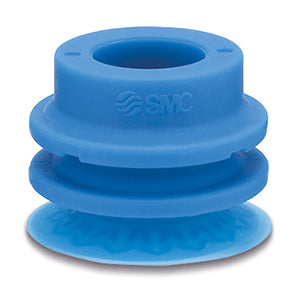
ZP3P-20JT2SF-WM
2.5 Stage Bellows with Guide Attachment - ZP3P-JT

ZSE20AF-T-01-J
ZSE20A(F), High-Pressure, Digital Pressure Switch, 3-Screen Display (IP40)

ZP2V-A5A5-07
ZP2V, Vacuum Saving Valve
Need advice or a quote?
Send us a list of part numbers or a short description of the task. We reply within one business day with prices, lead times and compatible alternatives.